
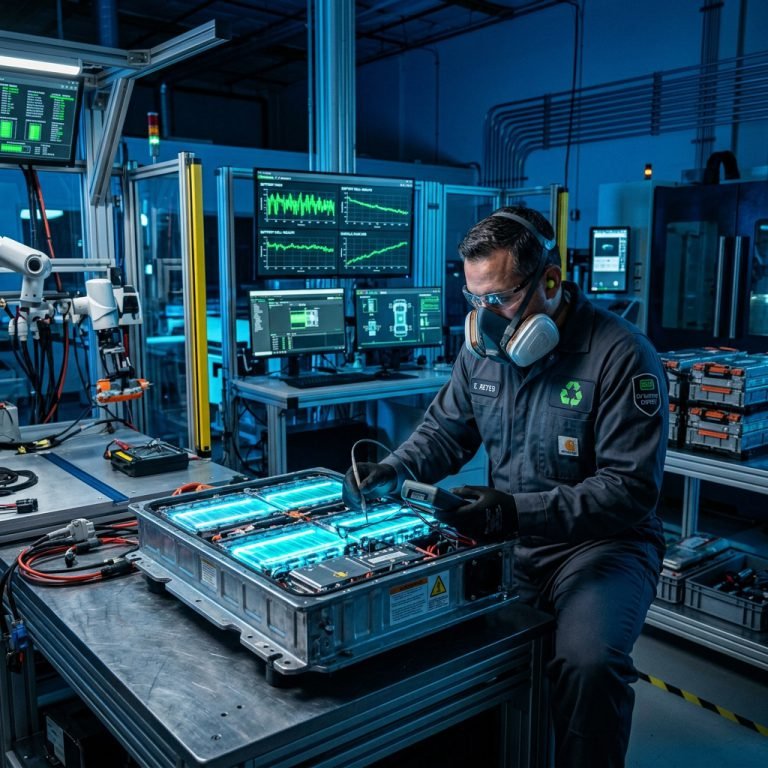
As electric vehicles (EVs) and hybrid cars become increasingly popular on Ontario roads, a new question is emerging in the automotive recycling industry: “What happens when these high-tech vehicles reach the end of their useful lives?” While traditional combustion engine vehicles are recycled for their steel, iron, and standard fluid content, electric vehicles present a completely different set of structural, chemical, and electrical challenges. Recycling a modern EV is a highly technical, specialized process that requires advanced training and equipment.
EVs vs. Traditional Cars: The Salvage Difference
In a standard gasoline or diesel vehicle, the primary mechanical value lies in the heavy cast-iron or aluminum engine block, the steel chassis, and the copper-rich wiring harness. In an electric vehicle, the internal combustion engine is replaced by a compact electric traction motor, and the heavy fuel tank is replaced by a massive, high-voltage **lithium-ion battery pack** that spans the entire floor pan of the vehicle.
This battery pack is both the most valuable and the most hazardous component of the vehicle. While a traditional lead-acid car battery weighs about 30 to 45 pounds, an EV lithium-ion battery pack can weigh between **800 to 2,000 pounds**, containing hundreds of individual high-voltage cells encased in heavy aluminum structures.
The Step-by-Step EV Scrapping Process
Recycling a hybrid or fully electric vehicle at a certified facility like City Scrap Car Removal involves several highly specialized phases:
1. High-Voltage Deactivation (The Safety Phase)
Working on an active EV battery pack carries a severe risk of high-voltage electrocution. Modern EV batteries operate at voltages ranging from 400V to over 800V—more than enough to be instantly fatal. Before any dismantling begins, certified technicians wearing specialized high-voltage personal protective equipment (PPE) must locate and pull the vehicle’s **Manual Service Disconnect (MSD)**. This physically cuts the electrical connection, dividing the battery pack into safer, lower-voltage sections.
2. Battery Pack Removal and Diagnostics
Once deactivated, the battery pack is carefully unbolted and lowered from the chassis using specialized insulated lifting tables. Wreckers perform diagnostic tests to evaluate the remaining state of health (SoH) of the cells. If the battery is still functional but has simply lost too much capacity for vehicle travel (e.g., degraded to 70% capacity), it is diverted to **Second-Life Applications**. These batteries are repurposed for stationary energy storage systems, such as solar power bank arrays or residential backup power grids.
3. Pyrometallurgical and Hydrometallurgical Recycling
If the battery is completely damaged or depleted, it is sent to specialized metallurgical recycling processors. These facilities use two primary methods to recover valuable elements:
- Pyrometallurgy: The battery cells are shredded and smelted at high temperatures, producing an alloy from which copper, nickel, and cobalt can be extracted.
- Hydrometallurgy: A chemical leaching process that dissolves the battery components, allowing for the precise recovery of lithium, cobalt, nickel, and manganese with extremely high purity (up to 99%).
These recovered metals are then shipped back to battery gigafactories to manufacture brand-new EV battery cells, creating a highly efficient circular economy.
The Salvage Value of Hybrid and Electric Vehicles
Due to the presence of valuable battery metals like lithium, cobalt, and nickel, as well as high-performance electric motors containing neodymium rare-earth magnets, scrap hybrid and electric cars possess a high baseline value. However, the labor and equipment costs required to safely dismantle high-voltage vehicles are also significantly higher. By partnering with a highly trained, certified direct buyer, you ensure that you receive an accurate, fair valuation for your end-of-life EV.
Conclusion
Electric vehicle scrapping is a highly specialized, safety-driven process that turns dangerous high-voltage waste into premium recycled metals and renewable power storage solutions. As Ontario’s EV market grows, certified wreckers are leading the way in sustainable auto disposal. Have an old hybrid or electric vehicle you want to scrap? Check out our Ontario Service Areas Directory to connect with our certified high-voltage salvage experts and secure a premium same-day payout today!